
A DIY Escape Room Alternative With No Kit To Build
A home-made escape room is a wonderful project. It's also a lot of work. Before your friends solve anything, someone has to write the story, design the puzzles, buy the locks, hide the clues and test the whole thing.
If you love that kind of making, go for it. If you just want the feeling of a group racing the clock to crack a code, there are easier ways.
What a DIY escape room at home actually involves
Guides to building your own escape room usually break it into steps like these:
- Pick a theme and a story.
- Decide on the goal: what does "escaping" mean?
- Design the puzzles and the order they unlock in.
- Buy or make the props: padlocks, boxes, UV pens, envelopes.
- Set up the room and hide everything.
- Test it with someone who hasn't seen it.
- Run the game, give hints and reset for the next group.
Every step takes longer than it looks. Puzzles that seem obvious to their creator often stump everyone else, and the other way round. And the person who built it can't play, because they know every answer.
Time and cost of building your own
The props alone add up: a few combination locks, a lockbox, printing and small puzzle items. Then there's the time. A good home-made room usually takes an evening or two of planning, plus setup on the day.
Ready-made options are cheaper than most people expect. A printable or boxed escape kit for the whole group typically costs about $15–$25. A live escape room venue is often around $100 for four players and takes about two hours door to door once you count travel, briefing and debrief.
Ready-made alternatives
Boxed escape games. A box with physical puzzles and envelopes that open in order. Satisfying to hold, but most can only be played once, and someone still has to read the instructions and hand out envelopes.
Printable escape kits. You buy a file, print it and cut it out. Cheap, but you need a printer, scissors and an hour of prep.
Escape-room apps. Some games run on one tablet that the group passes around. Easy to start, but often one person ends up holding the device while the others watch.
Phone-based escape games. Everyone plays on their own phone, and each player sees different information. Nothing to build, print or buy in advance.
Escape the Ahti: a phone-only submarine escape room
We built Escape the Ahti as a no-kit escape room. The submarine Ahti lies crippled on the seabed with 50 minutes of air left. Six locks stand between the crew and the surface: a blackout, a sonar contact, a pressure problem, a minefield, a radio message and the hatch.
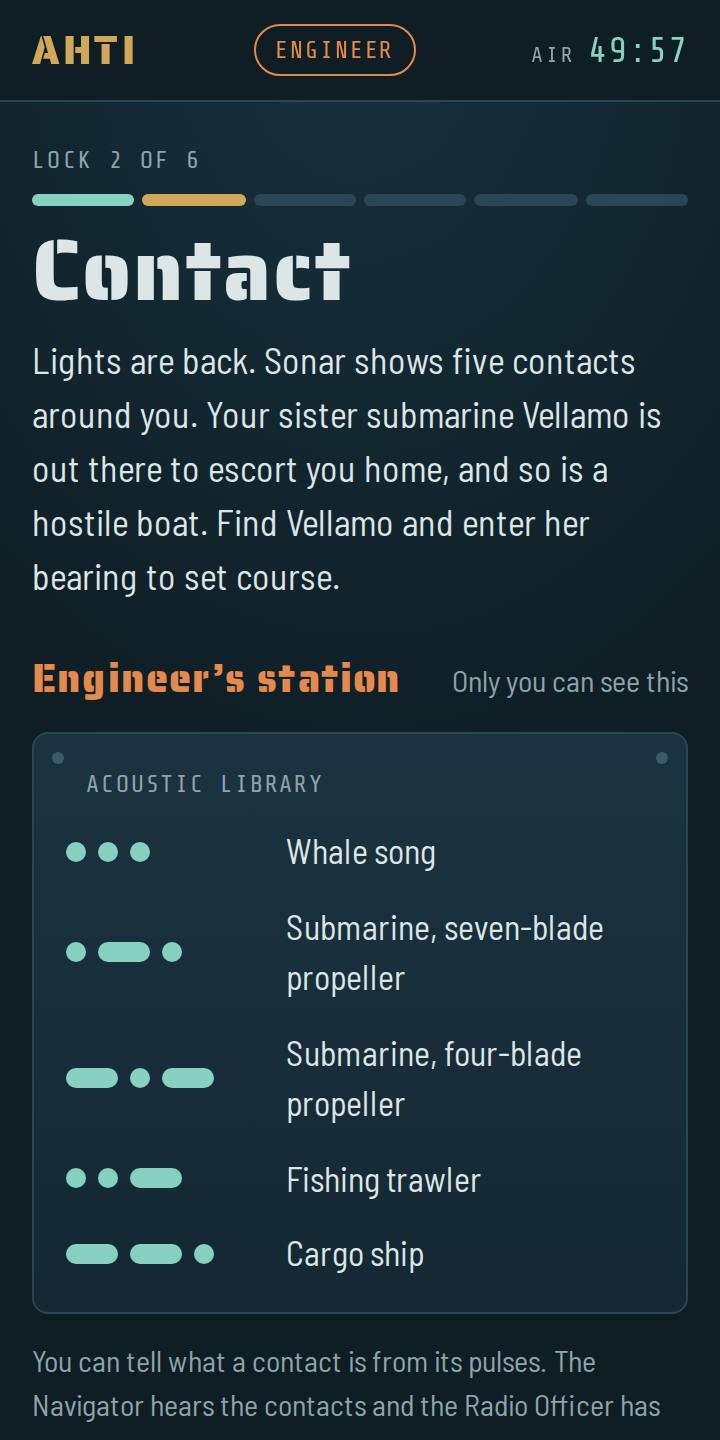
Each player takes a station on their own phone. In the first lock, the Engineer sees the breaker panel but not the order. The Captain has the orders but not the panel. The Navigator has the chart that links the two. The only way through is to say out loud what's on your screen, and that's where the escape-room buzz comes from.
It plays with 2 to 8 people. From 6 players, the group splits into two crews that race each other through the same six locks.
What you don't get compared to a physical DIY room
Be honest about the trade-offs:
- No physical props. You won't be fumbling with a real padlock or finding a key taped under a drawer.
- No custom story. A DIY room can be about your best friend's birthday. Ours is about a submarine.
- Screens are involved. Everyone looks at a phone, although the game only moves forward when you talk to each other.
In return, nobody spends a weekend building it, and the organizer gets to play too.
Choosing between DIY, a boxed game and a phone game
- Choose DIY if the building is the fun part and you have a free weekend.
- Choose a boxed game if you want physical puzzles and don't mind a one-time play.
- Choose a phone game if you want to start tonight, with no prep and no one left out as the game master.
See also: escape room at home, no kit to build.
Sources
- Steps of a DIY escape room: Escape Room Geeks, "DIY Escape Room: 7 Steps"
- Home kit and venue costs, and time door to door: DadSuggests, "Escape rooms for the family to do at home"